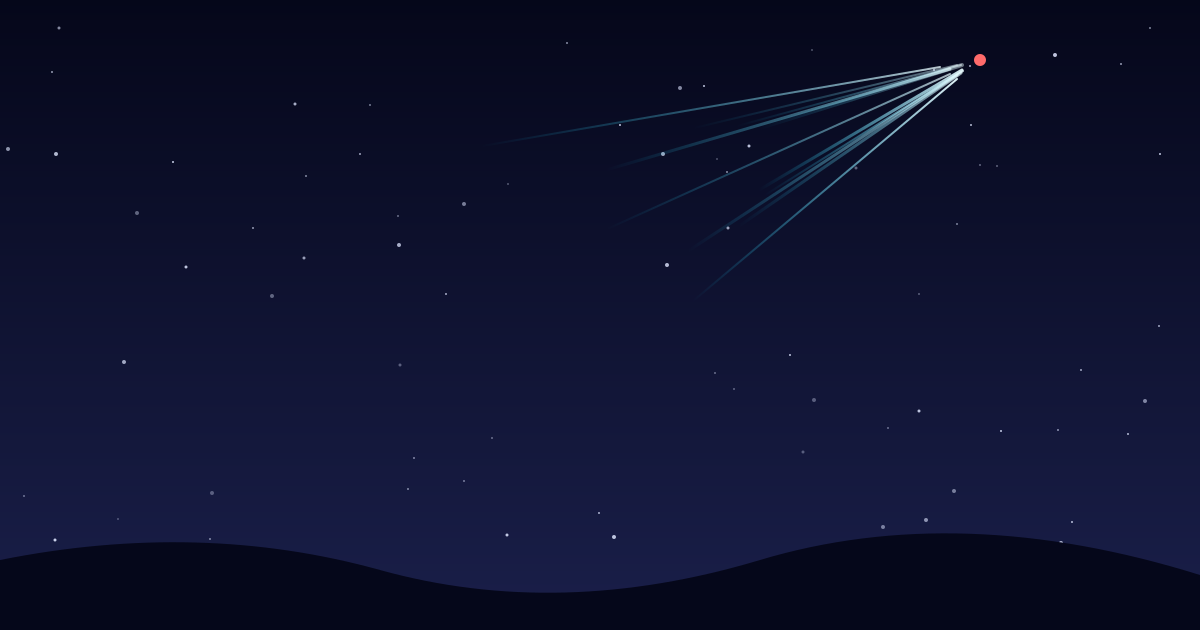
Every November, Earth drifts through a trail of dust left behind by a small comet. The dust hits our atmosphere at enormous speed, and each speck burns up in a bright streak. This is the Leonid meteor shower, and in 2026 it is expected to peak on the night of November 17 into 18, with the shower active from roughly November 6 through November 30.
Where the dust comes from
The Leonids come from Comet Tempel-Tuttle, which circles the Sun about every 33 years. Each time it passes, it sheds a stream of tiny grains, most no bigger than a grain of sand. When Earth crosses the stream, those grains slam into the upper atmosphere at about 44 miles per second, one of the fastest speeds of any major shower. That speed is why Leonids tend to be bright and quick.
Why the name has "Leo" in it
Meteor showers are named after the constellation they appear to come from. Trace the streaks backward and they seem to fan out from a point in Leo, the lion. That point is called the radiant. It is only a trick of perspective, the same way parallel railroad tracks seem to meet in the distance.
Storm years and quiet years
Most years the Leonids deliver a modest show, often a dozen or so meteors an hour under dark skies. But the shower is famous for its occasional storms. In 1833, people across North America described meteors falling like snow, and the event helped launch the scientific study of meteors. Storms returned in the late 1960s and again around 1999 to 2002. Forecasters do not expect a storm in 2026, so plan on a gentle show rather than a spectacle.
How to see more of it
- Go late. The radiant rises after midnight, so the hours before dawn are best.
- Get away from lights. Even a dark park beats a lit street. Let your eyes adjust for 20 to 30 minutes and avoid looking at your phone, or use a red light.
- Look wide. You do not need binoculars. Lie back and take in as much sky as you can, looking a little away from the radiant.
- Check the Moon. Moonlight washes out fainter meteors, and sources disagree on how much it will interfere this year, so look up the Moon's phase for your night before heading out.
- Dress warmly. Standing still in November is colder than it feels when you walk out the door.
Today's useful detail: the shooting stars you see are mostly grains of dust the size of sand, and they glow because they are moving at roughly 44 miles per second.